Finding the sweet spot between academic excellence and a fulfilling social life is the ultimate “holy grail” for undergraduate students. The transition to university life often feels like being thrown into the deep end, where the volume of reading and the complexity of assignments can quickly become overwhelming. However, mastering the art of academic writing isn’t just about working harder; it’s about working smarter so you can actually enjoy your time on campus.
The first step in taking control of your schedule is understanding the technical scope of your tasks. Many students lose hours simply because they underestimate the depth required for a specific paper. Before you even open a blank document, it is vital to gauge the expectations of your department. For instance, knowing how long is an essay based on your specific academic level allows you to “time-block” your week effectively, ensuring you aren’t pulling an all-nighter right before a deadline. When you have a clear roadmap of the word count and structural requirements, the writing process feels less like a mountain and more like a series of manageable steps.
The Foundation of Academic Success
Successful writing begins long before you type your first sentence. It starts with your environment and your mindset. In the world of “academic lifestyle” trends, many students are now adopting “Slow Living” principles. This doesn’t mean working slowly; it means working with intention. By eliminating digital distractions and focusing on a single task for 90-minute blocks, you can produce higher-quality work in half the time.
A common mistake is treating your study space like a storage unit. If your desk is cluttered with old coffee cups and unrelated notes, your brain will struggle to enter a flow state. Creating a dedicated “zone” for deep work helps signal to your subconscious that it is time to focus. When you step away from that desk, your brain can fully transition into “rest mode,” which is crucial for long-term retention.
Strategic Research and Evidence Gathering
One of the biggest hurdles for undergraduates is the research phase. It’s easy to get lost in a sea of academic journals without a clear direction. To stay organized, use a “Research Funnel” approach: start with broad overviews to understand the context, then narrow down to specific case studies and primary sources that support your unique thesis.
Efficiency here is key. Instead of reading every page of a 400-page book, learn the art of “skimming with purpose.” Read the introduction, the conclusion, and the first sentence of every paragraph. This allows you to identify if the source is actually relevant to your argument before you commit hours to deep reading.
| Research Stage | Objective | Tools/Resources |
| Discovery | Gain a broad understanding of the topic. | Library databases, Google Scholar. |
| Analysis | Identify key debates and gaps in literature. | Annotated bibliographies. |
| Synthesis | Connect different ideas to form a thesis. | Mind maps and outline drafts. |
Mastering Complex Disciplines
While general writing skills are transferable, certain subjects require a more nuanced approach. History, for example, isn’t just about dates; it’s about historiography—the study of how historical interpretations change over time. Navigating these complex academic waters can be daunting, especially when juggling multiple modules. For students looking to refine their analytical depth, engaging with a professional MyAssignmentHelp history essay writing service can provide the expert structural models and research foundations necessary to excel in such a specialized field. Having an expert example to follow helps you understand how to weave primary evidence into a compelling narrative while maintaining high academic standards.
The “Information Gain” Factor
To stand out in a sea of hundreds of student submissions, you need to offer something unique. This is what search engines and professors alike call “Information Gain.” Don’t just repeat what is in the textbook. Look for contemporary parallels to historical events, or apply a theoretical framework from one discipline to a problem in another. This cross-disciplinary thinking shows that you aren’t just memorizing facts; you are engaging with the material on a critical level.
Refining Your Voice: Writing for Humans
With the rise of digital tools, it’s more important than ever to maintain an authentic, human voice in your work. Professors aren’t looking for a string of “fancy” words; they are looking for clear, logical arguments. Avoid using overly “thesaurus-heavy” language that makes your writing feel stiff or robotic.
Focus on the rhythm of your sentences. If every sentence is the same length, your writing becomes monotonous. Mix short, punchy statements with longer, explanatory ones. This keeps the reader engaged and makes your arguments feel more dynamic. If you can explain a complex concept in simple terms, it proves you actually understand the material.
The Lifestyle Balance: Reclaiming Your Weekends
The secret to avoiding burnout is setting “hard stops” for your workday. Just as a professional athlete needs recovery time, your brain needs downtime to process information. Use the “Aura-Maxxing” concept for your study space—make it a place where you feel inspired, but leave the work there when you’re done.
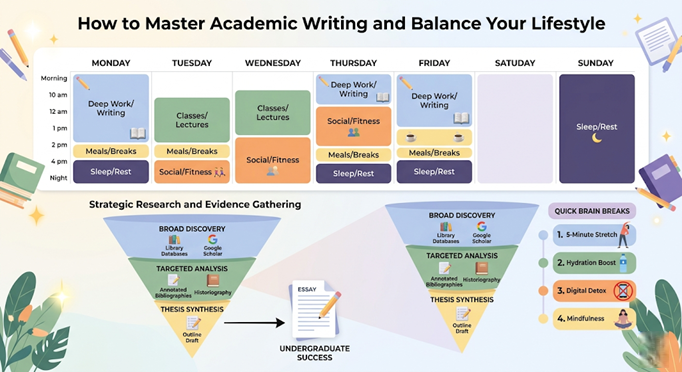
By being highly disciplined during your “on” hours, you earn the freedom to be fully present in your social life without the nagging guilt of unfinished assignments. Balancing your lifestyle means recognizing that your mental health is just as important as your GPA. A student who sleeps well and sees their friends is often more productive than one who spends 12 hours a day staring at a screen in a state of semi-procrastination.
The Final Polish and Submission
Before submitting any work, take a break for at least 24 hours. Reading your essay with “fresh eyes” allows you to catch logical gaps and grammatical slips that you would otherwise miss. Many students rush the final stage, but the “polish” phase is where a B+ becomes an A.
Read your paper out loud. If you find yourself running out of breath, your sentences are likely too long and need to be broken down for better readability. Check your citations one last time; consistent formatting is a sign of a disciplined scholar.
Frequently Asked Questions (FAQ)
1. How do I start an essay when I have writer’s block?
Ans: Start by writing a “zero draft.” Don’t worry about grammar or structure; just get your ideas onto the page. You can’t edit a blank page, but you can always refine a messy draft. Use bullet points if full sentences feel too intimidating at first.
2. Is it okay to use professional examples to improve my writing?
Ans: Absolutely. Reviewing high-quality academic models is one of the best ways to understand professional formatting, citation styles, and how to construct a persuasive argument. It provides a roadmap for your own original research.
3. How can I improve my writing speed?
Ans: Separate the “research phase” from the “writing phase.” When you try to do both at once, your brain constantly switches gears, which slows you down. Outline your entire essay first, then “fill in the blanks” with your analysis.
4. How do I know if my essay is too short or too long?
Ans: Most departments allow for a 10% margin above or below the word count. If you are significantly under, you likely need more evidence or a more detailed analysis of your sources. If you are over, look for redundant adjectives and repetitive points to trim.
5. How do I stay motivated throughout a long semester?
Ans: Break your big goals into “micro-goals.” Instead of saying “I need to write a 3,000-word paper,” say “I will find three primary sources today.” Small wins build the momentum needed to tackle larger projects without feeling burnt out.
About The Author
I’m Lachlan Nguyen, an academic strategist and content specialist at MyAssignmentHelp, where I focus on bridging the gap between rigorous university standards and modern student lifestyles. With a background in educational psychology and years of experience in the EdTech space, I empower students to move beyond rote memorization toward critical analysis and efficient research habits.